Design Principles · Family House Design
Timeless vs Trendy: Designing Interiors That Age Well
Every home is designed at a moment in time, and every moment has a look. The question is not whether to acknowledge it, but where to let it show. Timeless interior design is less about a particular palette than about knowing which decisions are permanent, which are easily reversed, and refusing to confuse the two.
What timeless interior design actually means
It is a structural idea before it is a decorative one.
Clients often arrive with the word already in mind. They want something that will still feel right in fifteen years, and they usually assume that means restraint — pale walls, quiet furniture, nothing that draws attention to itself. That is one route, but it is not the principle.
The principle is that a home has layers, and they move at different speeds. The architectural layer — how rooms are proportioned, where light enters, how you move between spaces — changes perhaps once in a generation. The fixed layer — joinery, stone, flooring, ironmongery, sanitaryware — changes every fifteen to twenty-five years, at real cost and real disruption. The soft layer — upholstery, curtains, rugs, lighting shades, art, accessories — can change whenever you like.
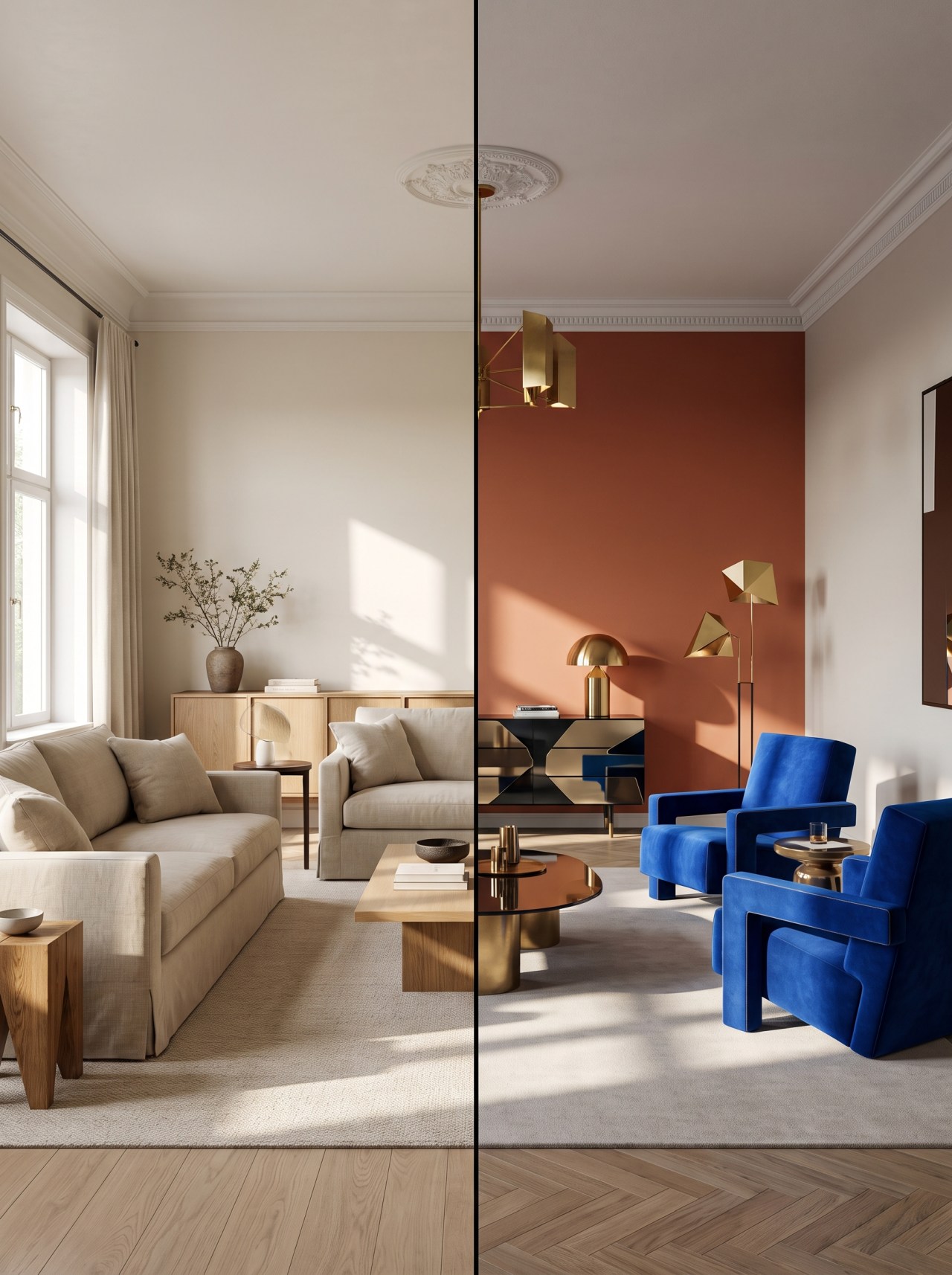
A scheme dates badly when a fashionable idea is built into a slow layer. It ages well when the slow layers are decided on their own merits and the fast layers are left free to move. That is the whole of it. Everything else is judgement about materials and proportion.
Where trends belong: a layer-by-layer view
The same idea can be a delight or a liability depending on which layer it lands in.
| Layer | Typical lifespan | Cost & disruption to change | How much trend it can carry |
|---|---|---|---|
| Architecture | A generation or more | Very high — structural works, consents, months on site | Almost none. Proportion and light should answer to the building, not the year. |
| Joinery | 15–25 years | High — bespoke remake, decorating made good | Very little. Keep the carcass and profiles quiet; express character in handles and finish. |
| Hard finishes | 15–30 years | High — wet trades, dust, rooms out of use | Little. Choose stone and timber for how they wear, not for how they photograph. |
| Fixed lighting | 10–20 years | Medium — ceilings and chases opened up | Some, in decorative pendants; none in the underlying lighting plan. |
| Loose furniture | 10–20 years | Medium — reupholstery extends it considerably | Moderate. Buy the frame for life; let the fabric date. |
| Textiles & art | 3–10 years | Low — a weekend, no trades | As much as you like. This is where a house should feel of its moment. |
Lifespans are indicative planning figures drawn from our project experience, not guarantees; every house and household wears differently.
How a considered budget tends to be distributed
Longevity is largely a question of where the money goes, not how much of it there is.
On the projects that hold up best, the proportions tend to look something like the split below: the permanent fabric of the house takes the largest share, and the visible, changeable surface takes the smallest. Where a scheme dates quickly, the same chart is usually inverted — a great deal spent on what is seen first and very little on what holds it up.
Illustrative proportions only, not fixed prices or a quotation. Every brief shifts these figures, and a house with sound services and a good plan already in place will look quite different.
Which decisions actually age well
A rough sense of how long different choices tend to look right.
It is worth being honest about the fact that nothing is truly immune. The chart below is a designer’s judgement rather than a measurement, but it captures something we see repeatedly: decisions rooted in proportion, natural material and craftsmanship hold their value, while decisions rooted in a specific published look have a short half-life.
Illustrative and based on professional judgement rather than fixed data. The bars describe relative longevity, not quality — a short-lived choice in a cheap layer is often exactly the right decision.
The materials question in timeless interior design
The most reliable test is what a surface looks like after five years of family life.
Showrooms present materials at their best moment, which is the least useful moment to judge them. The better question is how something behaves under wear. Materials that patinate — oiled oak, honed limestone, unlacquered brass, wool, vegetable-tanned leather, lime plaster — accumulate evidence of use and generally improve for it. A brass handle that has darkened where hands fall is more beautiful, not less.
Materials that depend on a flawless surface behave the opposite way. High-gloss lacquer, thin engineered veneers, and anything imitating a material it is not will only ever look as good as the day it went in. That is not an argument against them everywhere, but it is an argument against putting them in the slow layers of a house with children, dogs and daily traffic.
In our North London and Essex family projects this usually decides the specification. A hallway floor, a kitchen worktop and a boot-room bench are surfaces that will be tested tens of thousands of times. Specify those for the tenth year, not the first.
Making room for change
A scheme that cannot evolve is not timeless; it is simply frozen.
Designing for longevity is not the same as designing something finished. The homes we return to years later are the ones with enough structural generosity to absorb change: a picture-hanging system so art can move, sockets and lighting circuits placed for more than one furniture arrangement, joinery with adjustable shelving rather than fixed niches sized to today’s objects, curtain tracks that will take a different weight of fabric.
The most enduring rooms are not the ones that resist change. They are the ones that were built to accommodate it gracefully.
A children’s room designed with this in mind becomes a teenager’s study without a rebuild. A drawing room absorbs a new commission of art. This flexibility costs almost nothing at design stage and is close to impossible to retrofit, which is why it is one of the first conversations we have.
How we approach timeless interior design at Family House Design
Slow decisions first, and only then the pleasurable ones.
Our sequence is deliberate. We resolve plan, light and circulation before anything decorative is discussed, because those are the decisions that cannot be undone cheaply. Joinery follows, drawn to the room rather than the catalogue. Materials are selected against how the household actually lives. Only at the end do we choose the layer that carries personality most visibly — fabric, art, colour, the objects that make a house yours.
Clients sometimes find this order frustrating, because the exciting part comes last. But it is why the schemes hold. When the permanent layers are quiet and correct, a bold contemporary choice reads as confidence. When they are not, the same choice is doing the work of covering something up — and that is always visible, eventually.
Frequently asked questions
The questions clients raise most often about timeless interior design.
What is timeless interior design?
It is an approach in which the permanent layers of a home — layout, proportion, light, materials and joinery — are resolved on their own merits rather than in response to a passing look. The decorative layers can then change freely without the underlying scheme dating.
Does timeless mean neutral or beige?
No. Timeless interior design is about the quality and coherence of decisions, not the absence of colour. A deeply coloured library or a boldly veined stone can be entirely timeless if the proportion, material and craftsmanship are right. Equally, a beige room can date very quickly if its proportions are wrong.
Where should trends live in a scheme?
In the layers that are cheapest and least disruptive to change: cushions, art, lampshades, smaller occasional furniture, table linen and paint on secondary walls. Trends become expensive when they are built into joinery, tiling or fixed sanitaryware.
How do I know if a material will age well?
Ask how it looks after wear rather than on the day it is installed. Materials that patinate — solid timber, natural stone, brass, wool, leather, lime plaster — tend to improve. Materials that rely on a perfect surface finish, or that imitate another material, tend to look tired more quickly.
Can a timeless home still feel current?
Yes. A well-resolved architectural shell is the most flexible backdrop there is. Because the fixed layers are quiet and correct, contemporary furniture, art and textiles read as deliberate rather than as an attempt to keep up.
Designing a home meant to last
Prime London, North London and Essex.
If you are planning a renovation and want it to still feel right in fifteen years, the conversation begins with the parts of the house nobody photographs. We would be glad to have it with you.
Our Story
Interior Architect Ula Postek
Architectural Designer & Interior Architect